
This is spectacular. I bought it with mistrust at first. Afterwards I started using it and I'm happy. I love it. I like the graphics, the way they talk to you. It motivates you. It's great, it's like a personal trainer at home.
★★★★★
The rising cost of building muscle, and what it means for the nation’s health.

From chicken breast to ground beef, the cost of natural protein sources is rising, making it increasingly expensive for Americans to eat enough to support muscle health, healthy ageing, and overall wellbeing.
As household budgets remain under pressure, meeting recommended protein targets is becoming harder to afford. But rising costs shouldn’t mean people have to compromise on protein–an essential part of a healthy, balanced diet.
To see how the affordability of natural protein has changed, we analyzed 20 years of food prices, comparing them with inflation and salary growth to reveal how the cost of meeting recommended protein targets has changed over time, and the impact it could be having on many across the country.
Meet the expert

Nicolle Cucco is a registered dietitian, trained chef, and certified personal trainer. Nicolle currently serves as a nutrition consultant at Welltech, the parent company of Muscle Booster, following a diverse career in clinical, culinary, and educational roles. Her philosophy centres on balance across four pillars of health–nutrition, exercise, mental well-being, and rest–helping individuals build sustainable, holistic wellness routines.
Nicolle explains why getting enough protein is important not just for building muscle, but for supporting overall health, longevity, and wellbeing: “Protein is much more than a nutrient for building muscle. It’s essential for everyday bodily functions from repairing cells and supporting hormone production to maintaining healthy skin and aiding digestion.
“While many people associate protein with professional athletes and gym goers, getting enough is important for everyone. Building and maintaining muscle mass is vital for healthy ageing and long-term health, helping us remain as independent and mobile as possible while reducing the risk of injury from falls.”
Protein needs aren’t the same for everyone. Your ideal intake depends on factors such as body weight, activity levels, and health goals.
To make this easier to understand, we’ve grouped daily protein intake into three levels: general health, building and maintaining muscle, and high-performance training.
Using average government CDC body weights of 90kg for men and 77kg for women, we were able to work out recommended protein intake for each group.
General health — 0.8g per kg of body weight
For healthy adults, the recommended dietary allowance (RDA) is 0.8g per kilogram of body weight each day. This
equates to 72g of protein for males and 62g for females.
Building & maintaining muscle — 1.4g per kg
For those who regularly take part in training, around 1.4g per kilogram of body weight can help support muscle
growth, repair, and maintenance. This works out as around 126g for males and
108g for females.
High-performance training — 2g per kg
For people undertaking intensive training, protein intake needs are higher to support recovery. We’ve used 2g per
kilogram of body weight per day as our higher benchmark, equating to 180g per day for males
and 154g for females.
Please note: These figures are intended as general guidance rather than personalized nutrition advice.
To understand the cost of meeting different protein needs, we analyzed government-stored food price data[1] for five common natural protein sources: chicken breast, beef steak, pork loin, ground beef, and eggs. We calculated the cost per gram of protein[2] and used this to estimate the weekly cost of meeting each protein intake benchmark.
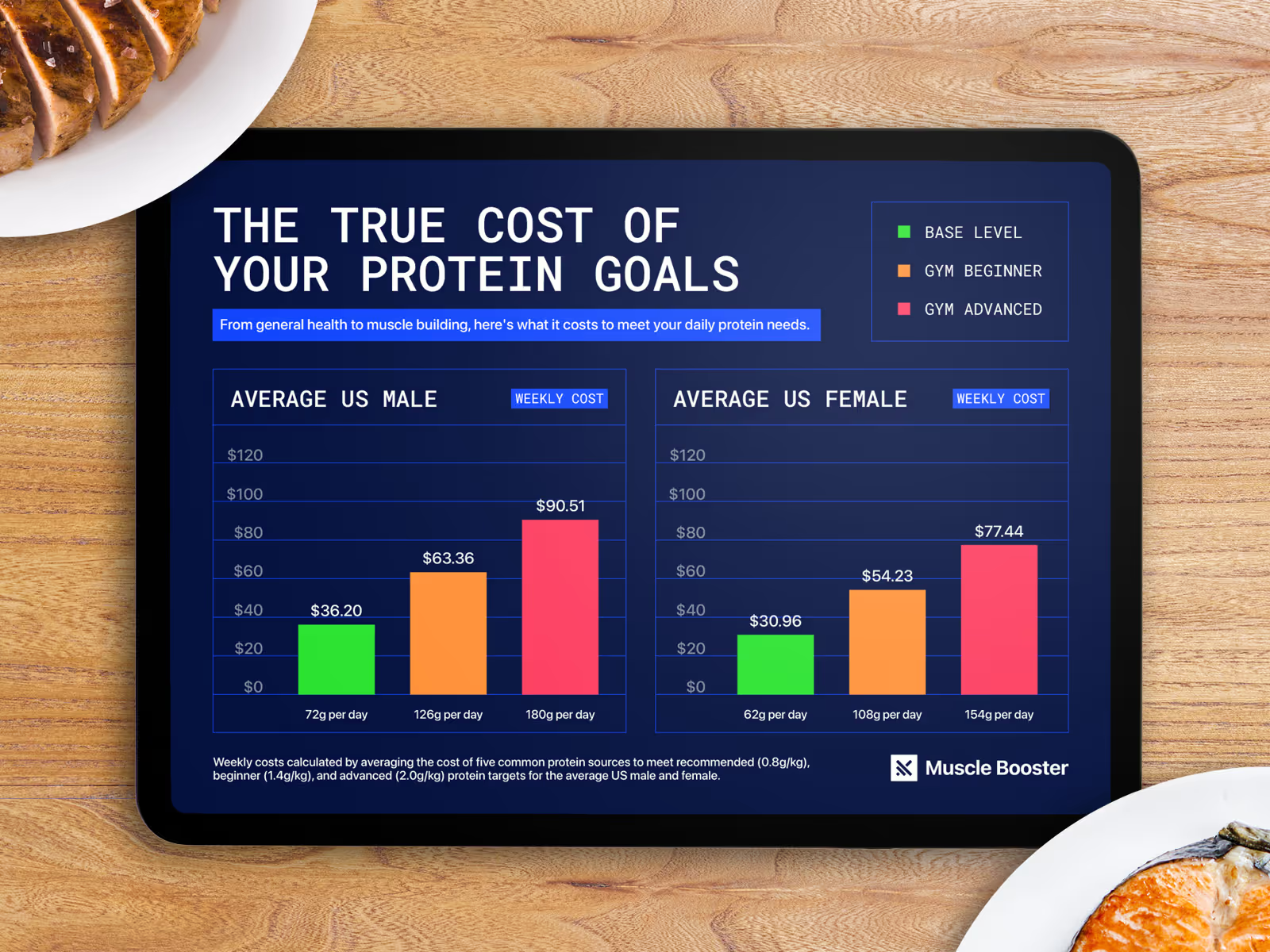
For the average American man, meeting recommended protein targets costs between $36.20 a week for general health and $90.51 for high-performance training using a diet based on common meat and dairy sources. For the average American woman, the equivalent cost ranges from $30.96 to $77.44 a week.
Vegetarian protein sources such as eggs, greek yoghurt, and cottage cheese are slightly cheaper overall, with weekly costs ranging from $20.33 to $50.83 for men and $17.39 to $43.49 for women, depending on activity level.
By comparison, a vegan diet composed of tofu, chickpeas, and red lentils offers the lowest-cost route to meeting protein targets. The average weekly cost ranges from $20.16 to $50.40 for men and $17.24 to $43.12 for women.
To put these costs into context, we compared them with the average US take-home pay.
According to government data[3], the US-wide average salary is $64,636, resulting in take home pay of roughly $4,485 a month–or $52,824 a year.
As most people meet their protein needs through a combination of different foods, we calculated the average cost across the five protein sources analyzed to understand how much of a person’s income would need to go towards meeting their recommended daily protein targets.
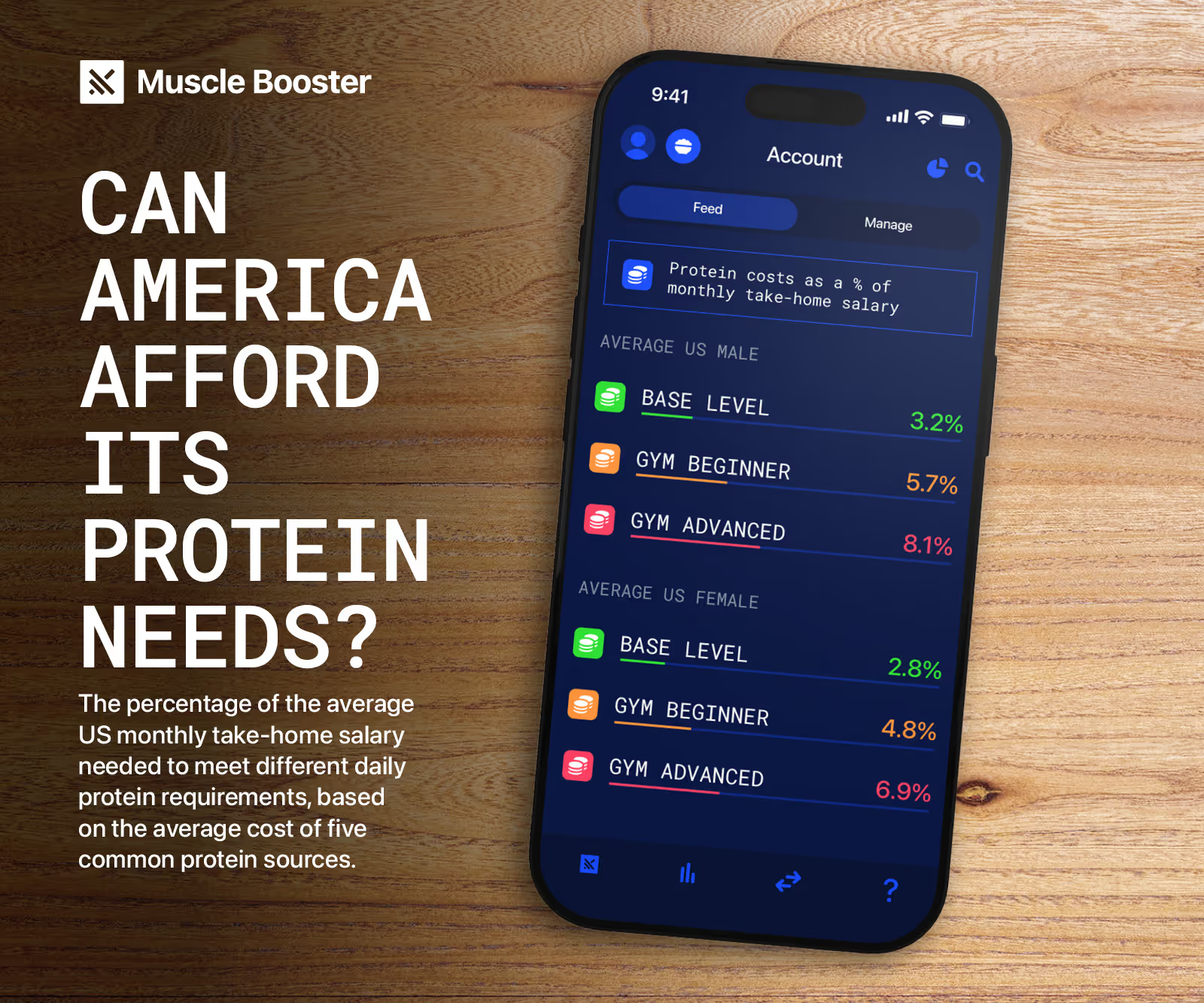
Meeting the baseline monthly protein requirement costs the average US man 3.2% of his take-home pay, compared with 2.8% for the average woman. For those aiming to build and maintain muscle, this rises to 5.7% and 4.8% respectively, climbing to 8.1% and 6.9% for high-performance training.
At that level, the average US man would need to spend roughly one in every twelve dollars he takes home each month on protein alone.
As some protein prices continue to rise faster than wages, maintaining a diet that supports muscle health, mobility, and healthy ageing is becoming an increasingly expensive commitment for many households.
Protein is clearly a significant expense for many households today, but has it always been this way?
To find out, we analyzed 20 years of government food price data comparing the price of common protein sources with inflation and average US wage growth. We call this ‘proteinflation’: how much faster protein prices have risen compared with the wider cost of living and what people earn.
2006 vs 2026 (20 years)
Over the past two decades, three out of five protein sources in our analysis have increased in price by more than inflation[4].
Since 2006, beef steak has become increasingly expensive relative to both inflation and earnings. Its average annual price growth of 4.6% was 2.1 percentage points above inflation and 1.5 points above wage growth. It also recorded the largest average annual cash increase, at around 42¢ per year.
Eggs have seen an even sharper rise in prices. A dozen eggs increased by an average of 5.8% annually, compared with inflation of 2.5% and wage growth of 3.1%—meaning egg prices rose almost twice as fast as average earnings.
However, not all meat has outpriced inflation and wage growth. Although chicken breast and pork loin both saw average annual price growth, it was below inflation and wage growth, at 1.4% and 1.8% respectively. This suggests that some protein sources have remained somewhat steady, while others have become increasingly costly for households.
Protein shouldn’t be an increasingly difficult part of a healthy diet to afford. Yet our analysis suggests that, over the past 20 years, certain products have become more expensive relative to both the cost of living and earnings–a trend we believe is worth addressing.
Meet the expert

Bruno Pontes is an ACSM and AFAA-certified personal trainer and group exercise instructor. For the past eight years, he has dedicated himself to helping individuals on their fitness journeys. He believes that fitness is for life and that movement is medicine. Bruno strives to make every workout fun, challenging, and purposeful, tailored to each person’s unique needs and goals.
For people trying to build or maintain muscle, rising food costs could make it harder to consistently get enough protein to meet their nutritional needs. And the impact goes beyond fitness goals, as protein plays an important role in strength, supporting healthy ageing, and staying active through life.
Bruno explains why getting enough protein and the right nutrition is important alongside regular exercise:
“Without the proper macros to fuel your body, you cannot fulfill your fitness goals. Either you’ll be too tired to exercise or you may not have the right amount of fuel to recover properly, leading to burnout or injury.
“Building muscle isn’t just about having bigger arms but can also help your body deteriorate at a slower rate and help improve longevity. Movement is one of the pillars to longevity, the more you move the longer you may live, so fueling correctly with enough protein is vital.”
But maintaining adequate protein intake isn’t just about reaching a gym target. Nicolle Cucco explains why protein and muscle strength remain important as we age:
“Protein is vital for strengthening our muscles, which help protect our joints, maintaining healthy bone density and preserving functional fitness and preventing incidents such as falls.
“If rising costs make protein harder to access, we risk making it more difficult for people to maintain the strength they need for everyday life.”
With protein prices rising, cutting back on protein shouldn’t have to be the answer. For people feeling the pressure of higher food costs, choosing a mix of more affordable protein sources and making a few simple swaps can help keep costs down without compromising on nutrition.
Foods such as chicken, eggs, dairy, beans, lentils and tinned fish can all provide high-quality protein, helping Americans hit their daily protein goals without relying on expensive cuts of meat or specialist products.
Nicolle explains that cost doesn’t always equal quality when it comes to protein:
“Your body doesn’t necessarily care whether your protein comes from an expensive steak or a more affordable source. What matters most is consistently eating enough protein as part of a balanced diet that provides the nutrients your body needs.
“Simple swaps can help make protein more affordable, whether that’s choosing frozen options, buying larger packs when they’re on offer, adding eggs to breakfast, including beans and lentils in meals, or using lower-cost dairy products and tinned fish.”
Bruno adds: “People can sometimes get caught up thinking they need expensive foods or supplements to build muscle, but the most important ingredients are consistency, enough protein, training, and recovery. The best approach is one that you can sustain both physically and financially.”
Sources:
[1] U.S. Bureau of Labor Statistics
[2] U.S. Department of Agriculture
[3] U.S. Bureau of Labor Statistics
[4] U.S. Inflation Calculator
To understand how protein affordability has changed over time, historical US retail prices for five commonly consumed protein sources were analysed: chicken breast, beef steak, pork loin, ground beef, and eggs.
Annual average prices from 2006 to 2026 were analysed using official US consumer price data from the U.S. Bureau of Labor Statistics. For each protein source, the overall price increase, average annual growth rate (CAGR), and average yearly change over the 20-year period were calculated.
To assess affordability, the cost of meeting different daily protein intake levels was calculated using each protein source individually. These costs were then compared against the latest US average salary to estimate the proportion of income required.
Estimated take-home pay was calculated using the average annual US salary of $64,636, assuming a single individual claiming the standard deduction. Deductions include federal income tax, Social Security, and Medicare (FICA), but exclude state and local income taxes, retirement contributions, and other voluntary payroll deductions.
All calculations were based on publicly available pricing data and standard percentage change and CAGR formulas. Prices represent annual averages and may vary by retailer, location, and product.
For the vegan and vegetarian foods comparison we calculated the cost per gram of protein for the top three protein food sources across four major US supermarket retailers.
People around the world are getting stronger with Muscle Booster. Here’s what they say about the App.