Are you ready to defy the odds and sculpt those muscles with a vegetarian twist?
Unleash the power of a well-crafted vegetarian diet to build muscle and leave behind the myth that plant-based eaters can’t gain strength. Before we dive in, don’t forget to get your personalized workout plan in the Muscle Booster app to build muscle mass and achieve your fitness goal faster.
Get ready to explore a world of delicious and nutrient-packed options tailored to your fitness goals!
Today’s guide will explain how muscle growth occurs, why it’s harder to gain lean tissue when not consuming animal products, and how to gain muscle as a vegetarian.
Can You Build Muscle on a Vegetarian Diet?
When your body’s muscle protein synthesis kicks into high gear, surpassing the breakdown rates, it’s like opening the floodgates for amino acids to pump up your muscles. [1]
But to achieve this muscle-building magic, you’ll need to ignite the spark with a training stimulus (think resistance exercises) and feast on enough dietary protein. With the right amino acid building blocks, you’ll be well on your way to a more powerful, chiseled physique! [1] [2]
And this is where most vegetarians run into trouble. They believe that the best forms of protein come from animal sources.
However, you may need to make some adjustments and be more detail-oriented when putting together a vegetarian muscle-building diet.
Why It’s Harder to Get Enough Protein if You Are Vegetarian
No surprise here, it is slightly harder to get enough protein on a vegetarian diet, and here is why:
Plant-Based Protein Has a Lower Absorption Level
Most people scoff at the idea of a muscle-building vegan diet because plant-based protein is more difficult to absorb, which means less of it is available to the human body following a meal.
As such, plant proteins might not have the same potent impact on the body as animal protein.
According to some sources, plant protein absorption is up to 20 percent lower than that of animal protein. [4] Because of that, vegetarians who want to build muscle should eat more protein to achieve the same absorption rate.
If a regular person needs 0.7 to 0.8 grams per pound to build muscle effectively, vegetarians should aim for up to a gram to be safe. [5]
Additionally, it might be beneficial to eat more frequently to maintain a steady stream of amino acids for muscle repair and growth.
Incomplete Amino Acid Profile
Protein comes in two primary categories:
Complete, which contains all nine essential amino acids
Incomplete, which lacks one or more of the essential amino acids
Animal protein is considered higher quality because it is complete, whereas plant proteins often lack one or more amino acids. [6]
Research published in the journal, Nutrients suggests that plant proteins don’t have the same anabolic effects as animal proteins because of their poorer digestibility, a lower amount of essential amino acids (including leucine), and the lack of other amino acids—lysine, sulfur, etc. [6]
So what’s the solution?
Here are a few plant-based protein combinations that result in complete, high-quality protein:
Barley and lentils
Beans and rice
Quinoa and sunflower seeds
Quinoa and amaranth
Tofu and hemp seed
Brazil nut and nutritional yeast
Check out our workout app, Muscle Booster, for personalized training guidance, effective workouts, and tutorials, over 2,500 healthy recipes, and more.
Very Little Leucine
Leucine is an essential amino acid with a crucial role in muscle protein synthesis. Not getting enough of it would limit growth and muscle recovery.
In addition to serving as an essential structural element in making new proteins, leucine can independently stimulate muscle protein synthesis. [8] [9]
That said, building muscle on a plant-based diet is still possible. Here is a list of plant-based protein sources and the amount of leucine you get per 100 grams of the source:
Dried seaweed – 4.9 grams
Hemp seeds – 2.1 grams
Chia seeds – 1.4 grams
Almonds – 1.4 grams
Sesame seeds – 1.3 grams
Oats – 1.3 grams
Cashew – 1.3 grams
Flaxseed – 1.2 grams
For reference, 100 grams of skinless chicken breast offers just over 1.9 grams of leucine. [10]
Additionally, you can consider a lactose-free protein powder to bump your nutrient intake.
Fewer Protein-Rich Foods are Available
Learning how to build muscle as a vegan or vegetarian can be challenging because fewer foods offer as much protein as meat, fish, and similar animal products.
Because of that, it can be challenging to reach the minimum protein requirement of 0.8 grams per pound (1.6 grams per kilogram), especially on a vegan diet. [5]
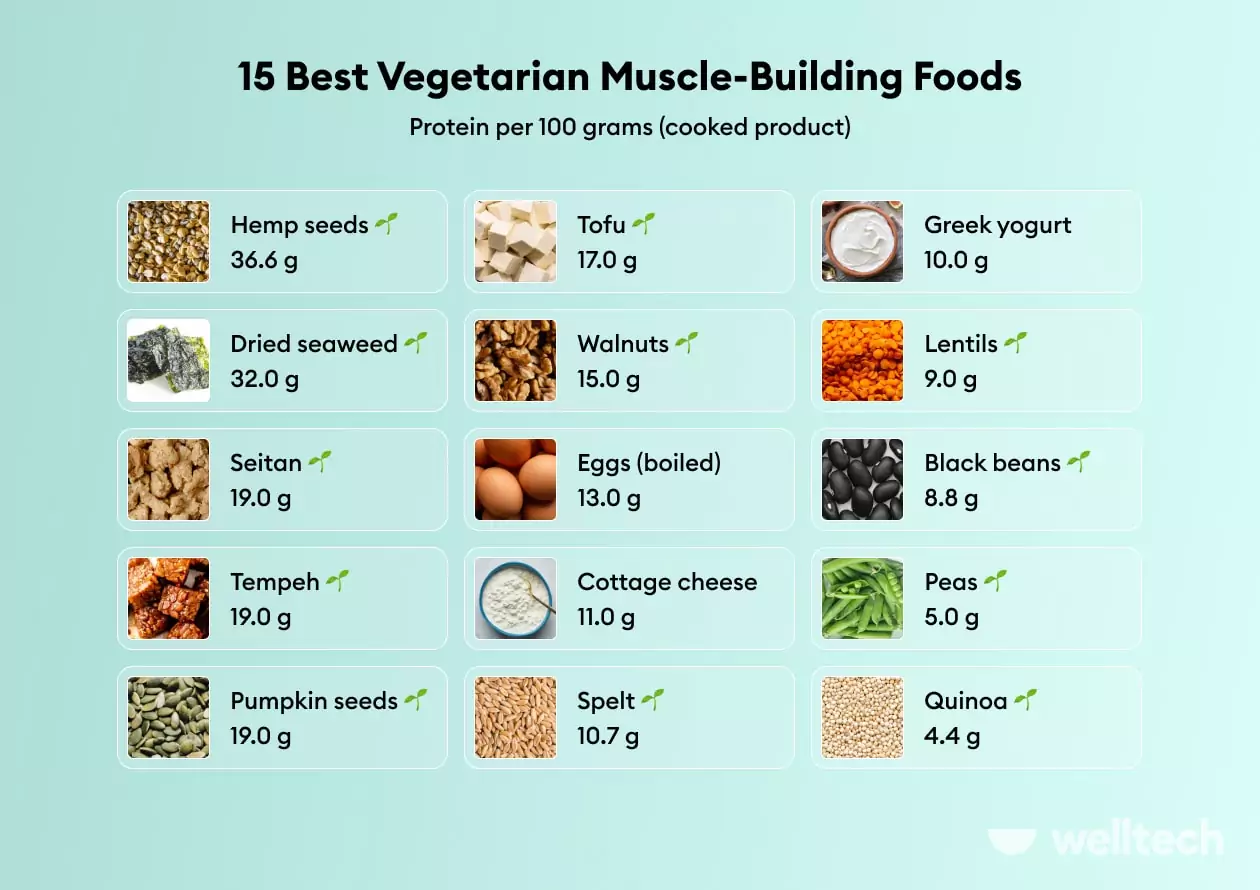
Vegetarian Diet To Build Muscle: 15 Foods to Eat Every Day
Here is a list of the 15 best vegetarian muscle-building foods, from most to least protein-rich:
Food | Protein per 100 grams (cooked product) |
Hemp seeds 🌱 | 36.6 grams |
Dried seaweed 🌱 | 32 grams |
Seitan 🌱 | 19 grams |
Tempeh 🌱 | 19 grams |
Pumpkin seeds 🌱 | 19 grams |
Tofu 🌱 | 17 grams |
Walnuts 🌱 | 15 grams |
Eggs (boiled) | 13 grams |
Cottage cheese | 11 grams |
Spelt 🌱 | 10.7 grams |
Greek yogurt | 10 grams |
Lentils 🌱 | 9 grams |
Black beans 🌱 | 8.8 grams |
Peas 🌱 | 5 grams |
Quinoa 🌱 | 4.4 grams |
As you can see, there is a way to set up a vegan diet for muscle gain, as you can enjoy multiple healthy, protein-rich foods.
Wrapping Up
Learning how to build muscle as a vegetarian can be a difficult process that requires good attention to detail. Fortunately, you can pick from plenty of high-protein vegan foods for muscle-building.
Here are some key takeaways:
Muscle growth (hypertrophy) occurs when protein synthesis rates surpass those of breakdown.
It’s possible to gain muscle on a vegetarian or vegan diet, so long as you eat enough protein-rich foods and provide a potent muscle stimulus.
Due to the lower quality of plant proteins and slightly worse digestibility, consuming more protein is best to ensure adequate protein synthesis. Up to a gram per pound of body weight might be necessary for vegetarians and vegans.
It’s best to mix your protein sources to ensure an adequate intake of all nine essential amino acids. A good example is combining tofu and hemp seed.
Given leucine’s importance for muscle protein synthesis, a good vegetarian diet to build muscle should include some foods rich in amino acid: almonds, dried seaweed, hemp seeds, flaxseeds, oats, and more.